| The ABCs of Blood 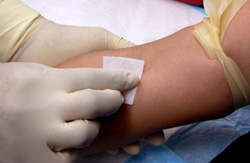 Blood has been called 'the river of life' and is one of the most commonly tested parts of our body. We often don't give it much thought until we cut ourselves, have it tested, or donate it. Blood has been called 'the river of life' and is one of the most commonly tested parts of our body. We often don't give it much thought until we cut ourselves, have it tested, or donate it.
Blood basics The average adult has five to six quarts of blood in their body. It's made from a number of components that have essential functions: - Red blood cells transport oxygen from your lungs to your body and remove carbon dioxide. They make up about 40 to 45 percent of your blood and give blood its color.
- White blood cells help fight infections.
- Platelets are cells that help form clots to stop bleeding.
- Plasma is the liquid part of your blood that transports sugar (glucose), vitamins, hormones, proteins, sodium, calcium, and other substances throughout your body. Plasma makes up about 55 percent of your blood.
Blood cells are made in the bone marrow, inside the large bones of your body. As older blood cells die, new ones are made to replace them. Blood tests Since your blood contains so many different substances, testing it can help shed light on how your body is functioning. Your doctor may have it tested to: - Evaluate how well your organs, like your kidneys, liver, and heart, are working.
- Diagnose diseases and conditions such as cancer, HIV/AIDS, diabetes, anemia, and coronary heart disease.
- Learn whether you have risk factors for heart disease.
- Check whether medicines you're taking are working.
Some of the most common blood tests your doctor may recommend are a complete blood count (CBC), blood chemistry tests, blood enzyme tests, and blood tests to assess heart disease risk. However, your doctor will need more than just blood tests to diagnose many diseases or medical problems. Your doctor may consider other factors, such as your signs and symptoms, your medical history, and results from other tests and procedures, to confirm a diagnosis.
Learn more about blood tests Anemia Anemia is a common condition in which your blood has a lower than normal number of red blood cells. This condition also can occur if your red blood cells don't contain enough hemoglobin, an iron-rich protein that helps red blood cells carry oxygen. If you have anemia, your body doesn't get enough oxygen-rich blood. As a result, you may feel tired and have other symptoms. Many types of anemia can be mild, short term, and easily treated. Some types can even be prevented with a healthy diet. Other types can be treated with dietary supplements. However, certain types of anemia may be severe, long lasting, and life threatening if not diagnosed and treated. Anemia occurs in all age groups and all racial and ethnic groups. Both men and women can have anemia, but women of childbearing age are at higher risk for the condition because they lose blood from menstruation.
Learn more about anemia 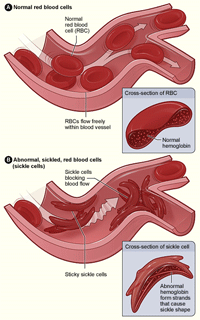 Sickle cell anemia Sickle cell anemia
Sickle cell anemia is one type of anemia. It's a serious disease in which the body makes sickle-shaped red blood cells shaped like a "C" due to abnormal hemoglobin. Normal red blood cells are disc-shaped and look like doughnuts without holes in the center, and move easily through your blood vessels. Sickle shaped cells are stiff and sticky and don't move easily through the blood vessels. The cells tend to form clumps and get stuck in the blood vessels. This can block blood flow in the vessels that lead to the limbs and organs and cause pain, serious infections, and organ damage. Sickle cell anemia is an inherited disease. Individuals who have the disease inherit two copies of the sickle cell gene—one from each parent. Sickle cell anemia is most common in people whose families come from Africa, South or Central America (especially Panama), Caribbean islands, Mediterranean countries (such as Turkey, Greece, and Italy), India, and Saudi Arabia.
Read more about sickle cell anemia Blood transfusion and blood types A blood transfusion is a safe, common procedure in which blood is given through an intravenous (IV) line in one of your blood vessels. Blood transfusions are done to replace blood lost during surgery or due to a serious injury. A transfusion also may be done if your body can't make blood properly because of an illness. Blood is transfused either as whole blood (with all the parts) or, more often, as individual components, such as red blood cells, platelets and clotting factors, or plasma. Each year, almost 5 million Americans need a blood transfusion. Everyone has either blood type A, B, AB, or O, and has either Rh-positive or Rh-negative blood. Thus if you have type A blood, it's either A positive or A negative. About 40 percent of the population has type O blood. People who have type O blood are called universal donors, as this blood type is safe for almost everyone. Type O blood is used for emergencies when there's no time to test a person's blood type. People who have type AB blood are called universal recipients, which means they can be given any type of blood.
Learn more about blood transfusions NHLBI-funded scientist Mark Robbins, Ph.D. on blood donation Blood transfusions can help many patients, including those with sickle cell disease, manage their conditions. There is a pressing need for African Americans to donate blood to increase the likelihood of a match with possible recipients. Dr. Mark Robbins and his research team at the University of Rhode Island are seeking ways to boost the number of blood donors within the African American community. The study is part of a grant awarded by the NHLBI with funding provided by the American Recovery and Reinvestment Act. To ensure a safe transfusion, the donor's blood must have the same antigens, or markers on the surface of the red blood cells, as the recipient's blood. Few people ever donate blood, and a majority of those who donate never do so again. A tiny fraction of the population, known as "super donors," is responsible for most of the nation's blood supply. A goal of Dr. Robbins research is to convince those who are contemplating becoming donors to take action. "Even a few percentage points could drastically expand the blood supply," notes Dr. Robbins.
Learn more about Dr. Robbins research Resources - Test your knowledge: Take the sickle cell anemia quiz
- NHLBI, CDC Launch Surveillance and Research Program for Inherited Blood Diseases (press release)
- List of organizations that focus on blood diseases and resources
|