 | 
Hector Balcazar, Ph.D., M.S., Spokesperson
 Video Clip: [Download the RealOne player] Video Clip: [Download the RealOne player]
Principal Investigator: Hector Balcazar, Ph.D., M.S.
Professor and Chair
Department of Social and Behavioral Sciences
Phone: (817) 735-0387
Fax: (817) 735-0324
E-mail: hbalcaza@hsc.unt.edu | University of North Texas
Health Science Center
Salud para su Corazón Outreach Initiative
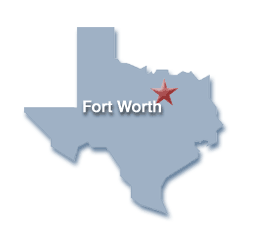
Forth Worth, Texas The target population includes low socioeconomic, Spanish- and English-speaking, underserved Hispanic adults residing in Forth Worth and the metroplex area of Texas. Using the Salud para su Corazón model, this project will use a multilevel approach to promote culturally and linguistically appropriate cardiovascular health and wellness activities to individuals and families in the target Latino communities. Specific strategies include: - Creating partnerships with community-based organizations, other agencies, and members of the community in an effort to reach Latinos who need cardiovascular health and educational services.
- Conducting training for Promotoras (lay health educators) who will be responsible for performing community dissemination and outreach activities.
- Conducting neighborhood and communitywide activities (e.g., guided group discussions, or "charlas," community health fairs, cooking demonstrations).
- Implementing family-based interventions that promote the role of the family in cardiovascular health education and health promotion.
- Developing individual and family action plans, using An Ounce of Prevention guide, designed to control cardiovascular disease (CVD) risk factors through heart-healthy behavior.
The proposed strategies will focus on all four National Heart, Lung, and Blood Institute (NHLBI) performance goals: - Prevent development of risk factors.
- Detect and treat risk factors.
- Recognize and treat acute coronary syndromes early.
- Prevent recurrence and complications of CVD.
This project aims to achieve the following outcomes among the Latino population: - Increased awareness and knowledge of heart-health behavior and stroke information.
- Reduced or controlled, modifiable, CVD risk factors.
- Improved compliance to medical and educational recommendations.
- Increased access to medical care.
- Decreased number of visits to emergency hospitals.
- Engagement of individuals and families in action plans that promote heart-health behavior.
- Improved communication among community partners.
|